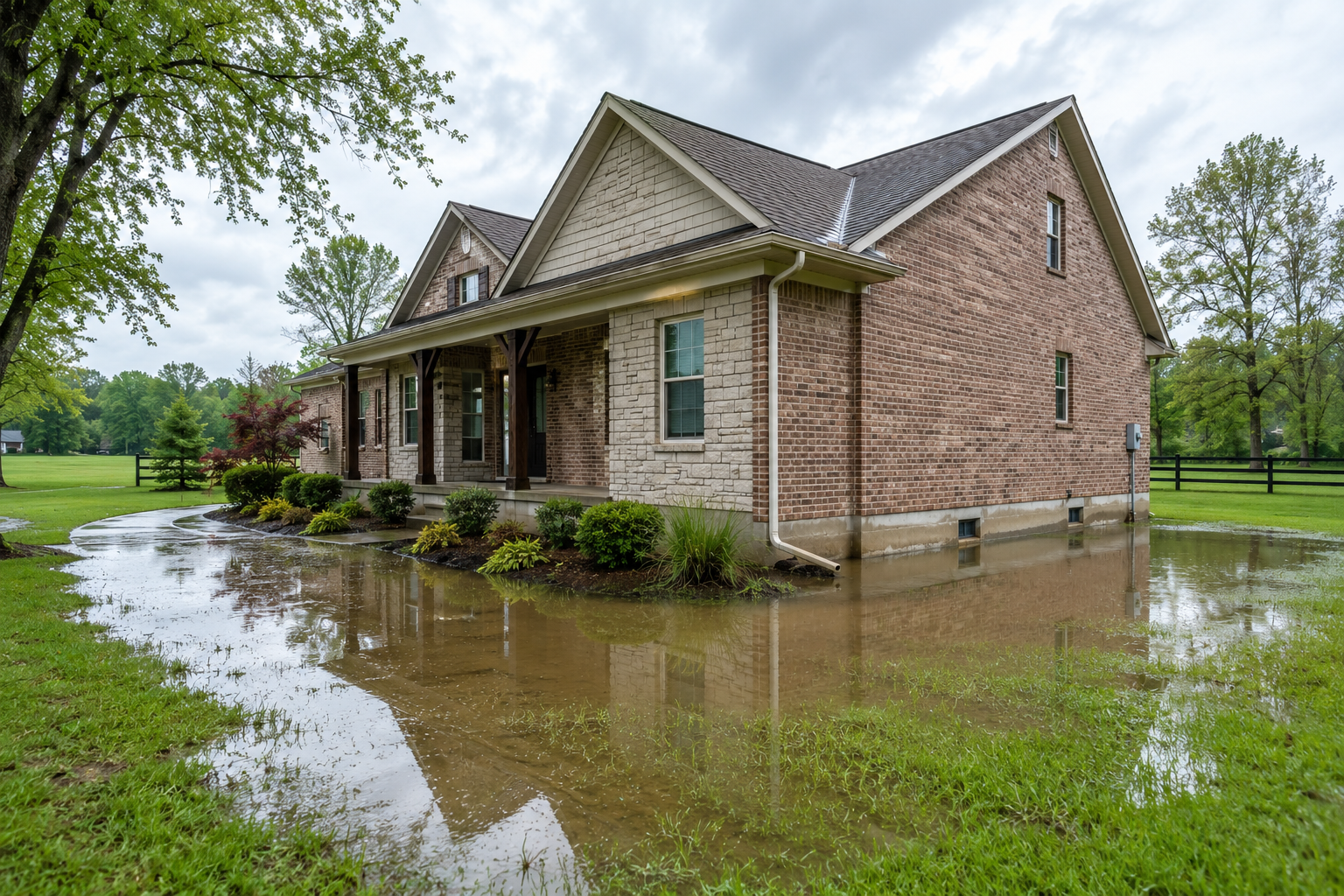
- Kentucky water-damage claims generally turn on the source of the water — flood, sewer backup, surface runoff, groundwater, or sudden pipe failure — because different sources fall into different coverage categories.
- Most standard KY homeowners policies generally exclude flood, exclude sewer or drain backup without an endorsement, exclude long-term seepage and groundwater, but cover sudden interior water from a covered cause like a burst pipe or storm-damaged roof.
- Anti-concurrent-causation clauses in KY policies generally only exclude loss where the excluded peril actually contributed to the specific damage — not damage from a separate covered cause that occurred independently.
- In Eastern KY counties hit by the July 2022 and 2025 floods, the dominant dispute pattern is whether basement and ground-floor water was flood (excluded) or covered water from another source. The classification often decides a five-figure outcome.
- At Property People Law, we read KY policies and develop the water-source record at no cost. Our KY residential and commercial property damage work is generally on contingency — we only get paid from the recovery, not your pocket.
Kentucky water-damage claims don't usually turn on the hurricane wind-first sequence that drives coastal causation disputes. KY doesn't have an Atlantic coastline. What KY claims turn on instead is the source of the water — and sources matter because different water sources fall into different coverage categories on a standard KY homeowners policy.
Flood is generally excluded across the industry. Sewer or drain backup is generally excluded unless an endorsement was added. Long-term seepage and groundwater are typically excluded as maintenance issues. Sudden interior water from a covered cause — a burst pipe, a failed appliance, a roof opening created by a tornado or severe storm — is generally covered. When water shows up in a Kentucky basement, on a ground-floor, or through a ceiling, the legal coverage question is which category of water it actually was.
This article walks through how KY water-classification disputes work, what each major water category does and doesn't cover, where carriers commonly push covered water into excluded categories, what evidence holds up against a water-classification denial, and how we at Property People Law approach KY causation cases. Every policy is different, every claim turns on its own facts.
How tornado and severe-storm wind interacts with covered water
Kentucky's wind exposure is heaviest in tornado outbreaks, derecho events, and severe thunderstorms, and the same causation framework applies on the wind side across those events.
When a tornado tears off part of a roof, the resulting interior water damage from rain entering through the wind-created opening generally remains covered as wind-driven rain through a wind-created opening. The chain runs: wind → opening → rain entry → interior damage. The carrier's flood exclusion generally doesn't apply because flood didn't enter the picture.
The December 10-11, 2021 tornado outbreak that devastated Mayfield generated this fact pattern at scale. The May 2025 tornado events that produced DR-4875 added more. Property owners with roof damage and interior water who received partial payments may have additional coverage available for water damage the carrier characterized as excluded but which actually flowed from a covered cause.
The same analysis applies in derecho and severe storm contexts. A blown-off section of siding, a debris-broken window, a wind-snapped tree puncturing the roof — each of these creates a covered chain when rain follows.
Flood: what it covers, what it doesn't
Standard KY homeowners policies generally exclude flood. "Flood" is typically defined to include overflow of inland or tidal waters, unusual and rapid accumulation of surface waters from any source, and mudslides or mudflows caused by accumulated water. NFIP coverage is the standard way to cover flood, and NFIP generally has to be purchased before a storm, not after.
The July 2022 Eastern KY flood and the 2025 flood events caused catastrophic flood damage across Perry, Knott, Letcher, Breathitt, Owsley, and Pike counties. Many affected property owners had no NFIP coverage. The result was that water damage from clear flooding was generally not recoverable, but property owners often still had claims for wind-related damage that occurred before flooding arrived, and for damage caused by sources other than the flood itself.
Whether a particular water loss was technically "flood" under the policy definition is sometimes itself contested. Heavy rain that accumulates faster than the storm sewer system can drain it may not fit the flood definition in every policy. Water that came through a wind-damaged roof and then pooled on the floor was wind-driven rain entry, not flood. Each policy's specific definition controls.
Sewer or drain backup: the endorsement that's usually missing
Sewer or drain backup is one of the most common KY water-damage scenarios — and one of the most commonly denied. A standard KY homeowners policy generally excludes water that backs up through a sewer or drain, unless an endorsement was added at issuance or renewal. The endorsement typically provides a separate $25,000 to $50,000 sublimit for sewer-backup damage at a premium cost of $30 to $80 a year.
When heavy rain overwhelms a municipal sewer system, water can back up through floor drains, basement plumbing, or sump pump failures. Without the endorsement, the resulting damage is generally not covered. The dispute that often follows is whether the water actually came in through the sewer system or through a different (potentially covered) source — through a wind-damaged roof, through wind-broken windows, through plumbing that failed inside the home.
Plumber's reports, sewer-line inspection records, and timing evidence are how this dispute generally gets resolved. If the basement filled with water through the sewer line during heavy rain, and no sewer-backup endorsement is in place, the denial may hold up. If the same basement filled with water from rain coming through a wind-damaged roof and pooling, the situation may be entirely different.
Surface runoff: the gray area
Surface runoff — rainwater that accumulates on the ground and then enters a property — sits in a coverage gray area on many KY policies. Some policies treat surface runoff as a flood-category event and exclude it. Some policies cover it. Some are silent enough that the answer depends on the specific facts.
A property at the bottom of a slope that took heavy rain may have surface water flowing under doors or through foundation walls. Whether that's "flood" under the policy definition or some other category often turns on the specific policy language and the source of the water. Some carriers argue that any unusually rapid accumulation of surface water is flood. Some courts have read flood definitions narrowly enough to exclude isolated surface-runoff events.
If a KY denial cites the flood exclusion for what was actually surface runoff or unusual rainfall accumulation, the policy definition is the place to start. Not every water-on-the-ground event is technically flood under every policy.
Groundwater and long-term seepage: the maintenance gap
Groundwater seeping through a foundation, long-term moisture issues, and gradual basement dampness are generally treated as maintenance issues that fall outside coverage. The policy isn't designed to fix water problems that develop over months or years — it's designed to address sudden losses from covered causes.
Where the line falls between sudden covered water and long-term seepage can be contested. A foundation crack that suddenly let water through after years of being dry may be on the sudden-loss side of the line. The same crack with steady moisture for years before a particular storm may be on the maintenance side. Documentation of when the property owner first noticed the issue, prior repair history, and home inspection records often decide the question.
Pipe burst and appliance failure: generally covered
Sudden discharge from a burst pipe, a failed water heater, a dishwasher line, a washing machine hose, or a similar covered cause is generally covered on most KY homeowners policies. The damage from the water that came out — drywall destruction, flooring damage, contents loss, mold growth from the covered water — generally falls inside coverage even when the source is dramatic.
The dispute on these claims tends not to be whether the loss is covered but how much of the resulting damage is covered. Mold growth from a covered water loss is generally covered up to the policy's mold sublimit. Hidden damage discovered later is generally covered if it relates back to the original sudden loss. Disputes arise when the carrier tries to characterize the loss as gradual rather than sudden — for instance, claiming the pipe had been leaking slowly before the actual burst.
How Property People Law approaches KY causation cases
When a KY property owner reaches out about a denied or contested water-damage claim, the first conversation is free and the framework is consistent. We read the policy carefully — flood exclusion language, sewer-backup endorsement status, gradual-versus-sudden water provisions, mold sublimit, and any other relevant endorsements.
From there we develop the water-source record. Plumber's reports, sewer-line inspection records, USGS rainfall data for the storm event, NWS public information statements, the property owner's photos and accounts, and the carrier's own claim file. We compare the carrier's classification of the water against the actual physical and timeline evidence. And we tell you whether the denial is defensible, whether wind-driven rain through wind-created openings applies, whether a sewer-backup endorsement should have applied, or whether the source classification itself is contestable.
Our KY residential and commercial property damage work is generally on contingency — we only get paid from the recovery, not your pocket. Past results in other cases don't guarantee outcomes in any new matter, and every claim turns on its own facts.