
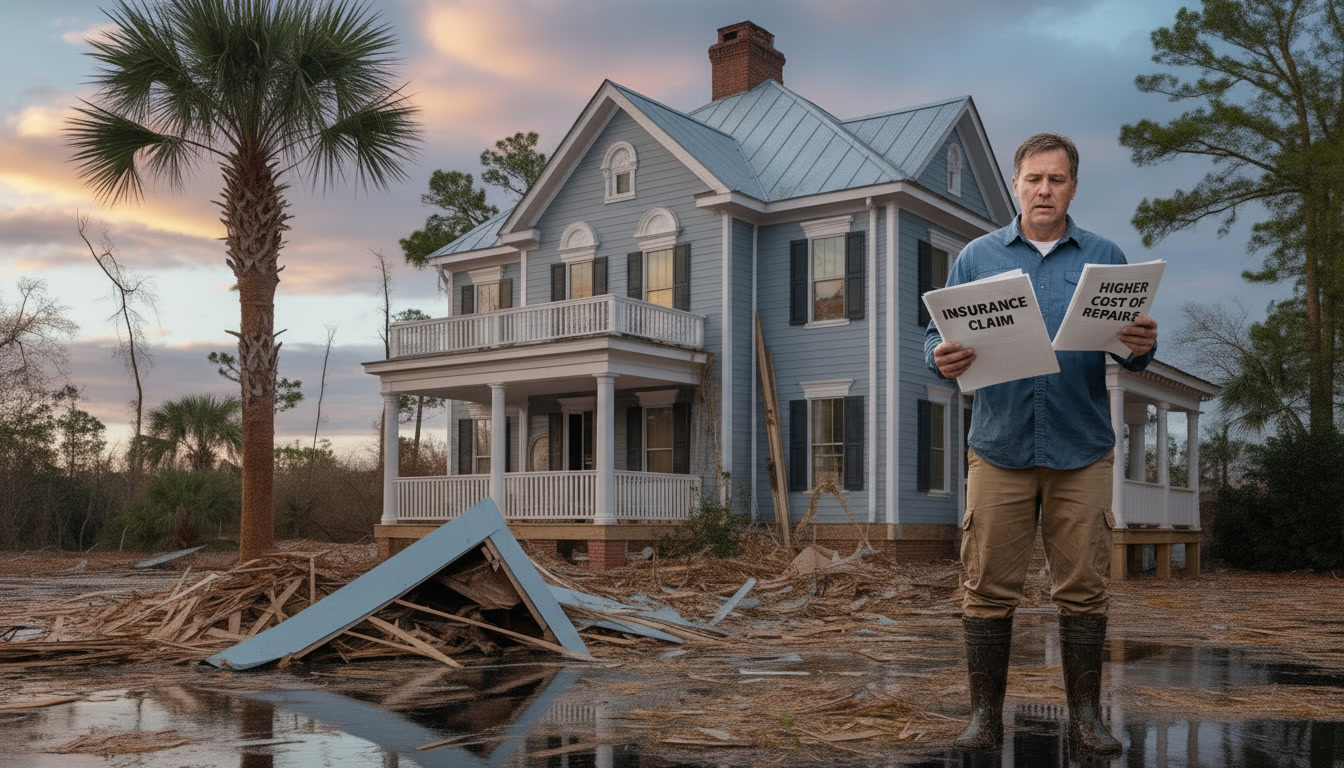
Hurricane Helene tore through South Carolina in September 2024, leaving a trail of destruction across the Upstate, Midlands, and Low Country. Nearly 5,000 homes were damaged. Forty-nine South Carolinians lost their lives. Entire communities were left without power for days as 21 tornadoes, hurricane-force wind gusts, and historic flooding swept across 33 of the state’s 46 counties.
For many South Carolina families, the storm didn’t just cause physical damage it triggered a second battle: fighting insurance companies that paid far less than the actual cost of repairs.
If you filed a Hurricane Helene insurance claim and found yourself paying thousands out of pocket to cover what your insurer refused to, you are not alone and you may not have to accept that outcome.
This article explains what underpaid hurricane claims look like, why insurance companies do it, what your legal rights are in South Carolina, and what steps you can take right now if you believe your Helene claim was shortchanged.
Hurricane Helene made landfall as a massive Category 4 storm on September 26, 2024, with sustained winds of 140 mph. While landfall occurred in Florida’s Big Bend region, the storm pushed significant wind, rain, and flooding damage deep into South Carolina well beyond the coast. Communities across the Upstate, including areas around Aiken, Spartanburg, Greenville, and Anderson, experienced flooding and wind damage on a scale not seen in generations. The Low Country and Midlands were hit with sustained wind, roof damage, and water intrusion that left many homes and personal property severely compromised.
South Carolina’s Emergency Management Division confirmed that Helene was the deadliest hurricane to impact the state in over 100 years, surpassing 1989’s Hurricane Hugo. FEMA has since provided more than $323 million in individual assistance to homeowners and renters across 28 declared counties and the Catawba Indian Nation.
The types of damage South Carolina policyholders reported most frequently after Helene included:
• Roof damage from wind and falling debris
• Water intrusion and interior flooding from rain-driven wind damage
• Mold growth resulting from delayed or inadequate repairs
• Damage to personal belongings, vehicles, and contents
• Structural damage from downed trees and debris
• Loss of use being displaced from your home while repairs were made
• Damage to driveways, fences, sheds, and other structures on the property
For many families, the damage was catastrophic. What happened next, the insurance claim process was often nearly as painful.
An underpaid claim doesn’t always look like an outright denial. Often, it’s subtler and that’s exactly how insurance companies prefer it. You receive a check, it feels like progress, and many policyholders cash it without realizing the payment falls far short of what their actual losses required.
Here are the most common signs your Hurricane Helene claim may have been underpaid:
This is the clearest sign of an underpaid claim. If your contractor’s estimate was significantly higher than what your insurer paid and you covered the difference yourself that gap may represent compensation you’re still legally owed. Insurers frequently use their own preferred contractors or pricing databases that underestimate real-world repair costs, especially in a post-storm environment where labor and materials are in high demand.
Insurance adjusters, especially those deployed rapidly after a major storm, use standardized software like Xactimate to estimate repair costs. These tools frequently undervalue storm damage, miss secondary damage (like mold caused by water intrusion), and don’t account for local labor rates or current material costs in markets like Greenville, Spartanburg, or Aiken. If your contractor looked at the same damage and came back with a much higher number, the discrepancy deserves scrutiny.
A common tactic: attributing damage to a cause that’s excluded from your policy rather than the storm itself. For example, your insurer may claim that water damage was due to pre-existing wear rather than Helene’s rain and wind. Or that structural issues were caused by age rather than the storm’s impact. These causation disputes can dramatically reduce your payout and they’re frequently overturned successfully with the right legal help.
One of the most frustrating outcomes for South Carolina policyholders after Hurricane Helene is receiving a determination that the damage to their home falls below their hurricane or named-storm deductible resulting in zero payout from the insurer.
Here’s how it works: many South Carolina homeowners policies include a separate hurricane or wind/hail deductible that is calculated as a percentage of the home’s insured value typically between 1% and 5% rather than the standard flat-dollar deductible you’d pay for a fire or theft claim. On a home insured for $400,000 with a 2% hurricane deductible, that means the first $8,000 of covered damage comes entirely out of the homeowner’s pocket. The problem is not just the size of the deductible itself. Insurers regularly minimize the total damage estimate so that it falls just at or below the deductible threshold allowing them to close the claim without paying anything at all. They achieve this by undervaluing the scope of damage in their inspection, excluding items that should have been included, or using conservative pricing that doesn’t reflect actual repair costs.
If your insurer told you your Hurricane Helene damage did not exceed your deductible, it is critical to have that determination reviewed. An independent contractor’s estimate or a review by an experienced property damage attorney may reveal that the true cost of your repairs significantly exceeds the deductible. In those cases, you may be entitled to the full amount above the deductible that should have been paid from the start.
Most standard homeowners policies include coverage for Additional Living Expenses (ALE) meaning if your home was uninhabitable after Helene, your insurer should have covered your temporary housing, meals, and related costs while repairs were completed. Many policyholders don’t realize this coverage exists, and insurers don’t always volunteer it. If you were displaced and paid those costs yourself, you may be owed reimbursement.
Understanding why underpayment happens helps you recognize it when it occurs. Insurance companies are for-profit businesses and after a large-scale disaster like Hurricane Helene, they face enormous financial pressure. The result is a systematic approach to minimizing claim payouts that can leave policyholders holding the bill.
• High volume, fast processing. After a major storm, insurers deploy large numbers of adjusters to process claims quickly. Speed often comes at the expense of accuracy and the errors almost always favor the insurer.
• Low-ball software estimates. Programs like Xactimate are widely used by insurers to calculate damage costs. When inputted conservatively, they can produce estimates well below actual contractor quotes.
• Partial approvals. Insurers sometimes approve part of a claim while quietly denying or ignoring other covered damages hoping policyholders won’t notice or won’t push back.
• Depreciation disputes. Insurers calculate “actual cash value” by depreciating the age of damaged items often aggressively which significantly reduces the payout even when replacement cost coverage exists.
• Manipulating deductible thresholds. Insurers may undercount damage specifically to keep the total below your hurricane or named-storm deductible, eliminating their obligation to pay anything.
• Counting on policyholders accepting the first offer.Many people exhausted, displaced, and overwhelmed simply accept what the insurer offers. Insurers know this, and first offers often reflect it.
South Carolina law provides important protections for policyholders who believe their insurance claim has been mishandled. If your Hurricane Helene claim was underpaid, delayed without reason, or handled in bad faith, you have legal options and you don’t have to navigate them alone.
Accepting an insurance payment does not necessarily mean you’ve waived your right to seek additional compensation. In many cases, South Carolina policyholders can reopen a claim, submit additional documentation, or formally dispute the insurer’s valuation particularly if new damage is discovered or contractor estimates significantly exceed what was paid.
If your insurer concluded that your Hurricane Helene damage fell below your hurricane deductible, you have the right to challenge that determination. An independent assessment of the damage supported by a licensed contractor’s estimate and, where necessary, expert analysis may show that the actual cost of repair significantly exceeds the insurer’s estimate. You are not required to accept your insurer’s valuation as final.
Under South Carolina law, insurance companies have a duty to handle claims fairly and in good faith. If your insurer unreasonably delayed your claim, ignored evidence of covered damage, made lowball offers without basis, or otherwise acted improperly, you may have grounds for a bad faith insurance claim which can result in compensation beyond just the original policy benefits.
There are time limits on how long you have to pursue an underpaid or denied insurance claim in South Carolina. These deadlines vary depending on your policy terms and the nature of the dispute, but waiting too long can eliminate your options entirely. Given that Hurricane Helene struck in late September 2024, that window is already narrowing. If your Helene claim was settled and you believe you were shortchanged, the time to act is now not later.
If any part ofthis discussion sounds familiar if you paid out of pocket, if your repairs cost more than what your insurer covered, if your claim was closed as “under the deductible,” or if you feel like you got less than you deserved here are the steps to take right now:
1. Gather your documentation. Collect your originalclaim, the insurer’s payout breakdown, contractor estimates, receipts for any out-of-pocket expenses, photos of the damage, and any written communications with your insurer. The more documentation you have, the stronger your position.
2. Get an independent contractor estimate. If you haven’t already, have a licensed South Carolina contractor assess the damage and provide a written estimate. A significant gap between this estimate and what your insurer paid is one of the strongest pieces of evidence in a dispute.
3. Review your policy carefully. Know exactly what coverage you purchased including wind, water, contents, Additional Living Expenses, and your hurricane or named-storm deductible. Understanding what you were entitled to is the foundation of any dispute.
4. Do not sign a release without legal advice. Ifyour insurer is asking you to sign any document releasing them from further liability in exchange for a payment, consult an attorney before signing. Releases can permanently close your ability to seek additional compensation.
5. Contact a South Carolina insurance claim attorney. An experienced attorney can review your claim, identify where you were underpaid, challenge deductible determinations, and fight on your behalf often at no upfront cost. At The Property People Law, we only get paid when you do.
South Carolina families affected by Hurricane Helene have been through enough. If your insurance company didn’t hold up their end of the deal, if you paid out of pocket for damage they should have covered, if your claim was low balled, denied, or closed as under the deductible you deserve to know your options.
The Property People Law’s attorneys specialize in fighting underpaid and denied insurance claims across South Carolina from the Upstate to the Low Country. We know how insurers operate, we know how to build a case, and we don’t get paid unless you do.
A free case evaluation costs you nothing and could put you on the path to recovering what you’re rightfully owed.